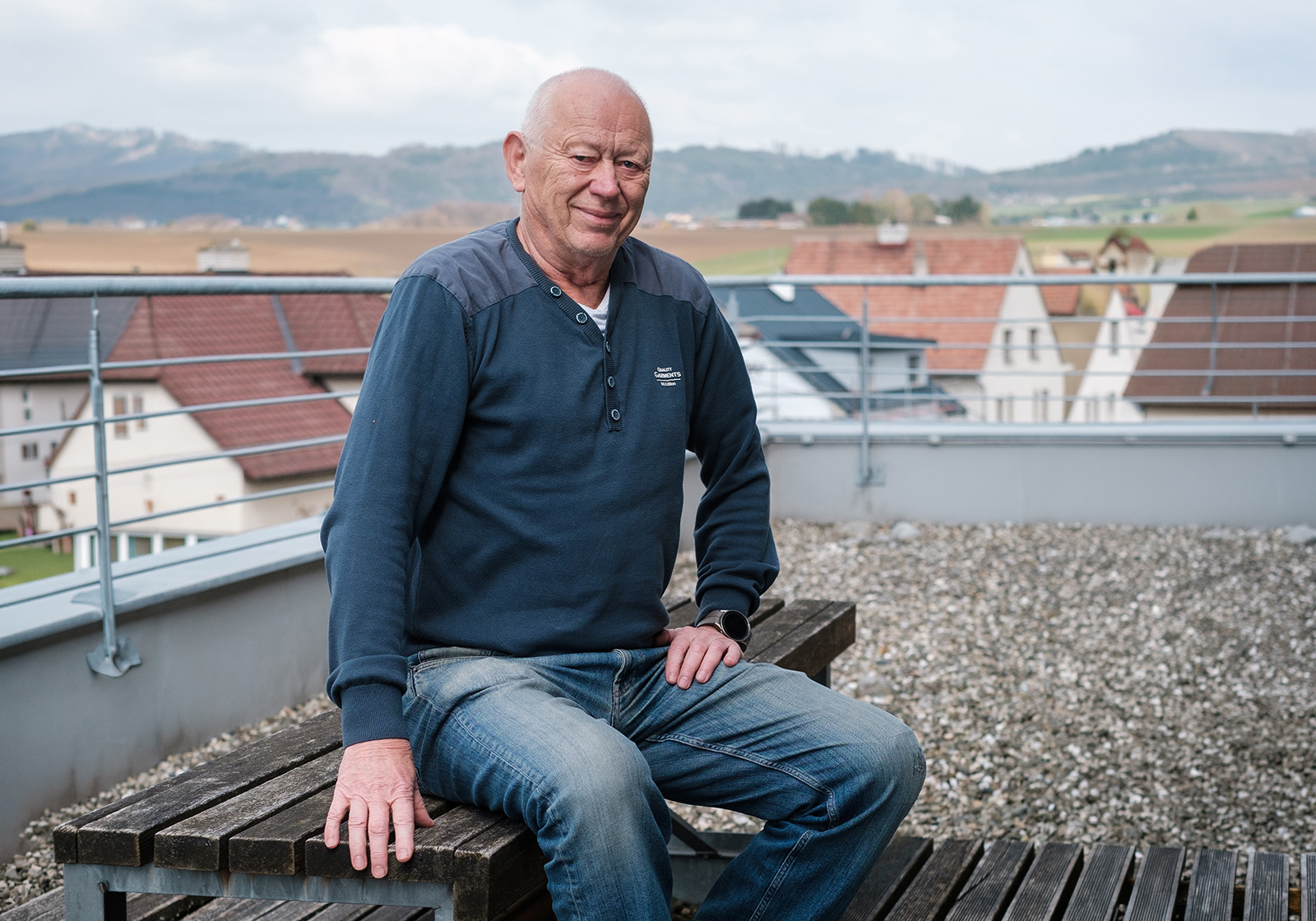
Milan Šimek joined the company shortly after its founding and was put in charge of the service department. In this interview, he recalls how the world feared the collapse of computer networks on New Year’s Eve 1999 and why, in the early days, he had to sleep with a banking terminal right next to his bed.
Mr. Šimek, you joined Monet+ essentially at its very beginning. What kind of projects was the company working on back then?
I joined the service side of the company around 1999. At that time, we had basically one single, but massive, customer—the Slovak gas station network Benzinol, which later became Slovnaft. We developed a system for them called Kredit. Back then, data transfers didn’t really exist yet, so everything was handled offline. A group of us was formed, and we had to physically visit every single gas station in Slovakia to install the terminals. It was a huge number of terminals; we drove our own cars and solved problems right on-site, sometimes in tiny booths where there wasn’t even room for the cables.
What was the real business benefit for Benzinol at the time?
It was enormous. Up until then, they had significant cash leaks and embezzlement directly by employees at the stations. By introducing our system, these frauds dropped to practically zero overnight. All the money they invested in the system was returned to them incredibly quickly. We built a huge reputation for ourselves there.
That sounds like a proper “baptism by fire” for new employees.
It certainly was. For instance, Zdeněk Skalák, who still works here today, started as a complete rookie fresh out of school. On his first day at work, I loaded him into a car, drove him to the headquarters in Bratislava, and he sat there for twelve hours a day uploading applications into terminals during the rollout of the Bonus system for Slovnaft. Apparently, it didn’t scare him off.
You were also in charge of the legendary Y2K transition when the world feared a global computer network crash. Where did you spend that New Year’s Eve?
Slovnaft asked us to have personal supervision over the systems at midnight. I volunteered to spend New Year’s Eve directly at Slovnaft. They cooked us their traditional kapustnica (cabbage soup), and after midnight, we called all the gas stations to see if everything was running. Fortunately, absolutely nothing happened—everything worked, and everyone was happy.
Then came the massive ASORS project for ČSOB bank, which still processes a huge volume of transactions today. What was it like collaborating with such a large bank?
The beginnings were brutal. We were managing the immense load of thousands of terminals that all had to dial into us from across the country at the same moment. Occasionally, the system would crash at night and had to be physically rebooted. Today, 24/7 support lines are standard, but back then, I had a terminal by my bed that I used to bring it back up. I also remember a situation when it crashed at 2:00 AM. I called our lead programmer, Mr. Nesiba; his wife picked up and said: “He’s at the pub.”„On je v hospodě.“ So, I got in the car, went to the pub to find him, and we solved the problem immediately. The customer never even found out.
Did you experience any other crisis situations with these banking systems?
The major floods in Prague were a huge test. ČSOB had its servers located near the river, and the water was constantly rising. It stopped just ten centimeters below our servers. There was a real threat that everything would be submerged and stop working, but luckily, we survived by those few centimeters.
The major floods in Prague were a huge test. ČSOB had its servers located near the river, and the water was constantly rising. It stopped just ten centimeters below our servers. There was a real threat that everything would be submerged and stop working, but luckily, we survived by those few centimeters.
Yes, you can find our systems at the State Printing Works of Securities, for example. We developed digital tachographs, which replaced paper discs for truck drivers. And today, we supply software for the production lines used to personalize the smart cards in Czech IDs, driver’s licenses, and passports. I dare say that, thanks in part to us, Czech electronic passports are among the absolute best in the world.
When someone asks you today what Monet+ actually does, how do you explain it to the uninitiated?
It’s much easier to explain these days. I tell them: “Look at your passport, your ID, or your driver’s license. Or think about when you pay by card at a terminal in a supermarket.” They realize that we made the software inside. I feel an immense sense of pride in how far this originally small Zlín firm has managed to get.
The company has grown tremendously in recent years and last year won the prestigious Company of the Year 2025 title. How has the corporate culture and atmosphere changed since the early days?
At the start, there were about twenty-three of us; we knew each other perfectly and knew exactly who was doing what. It was much more like a family. Our headquarters is still in a building that the local collective farm (JZD) once built as a giant recreation center—there was even a swimming pool, which is now hidden under the office floors. We used to go on a lot of intimate team events, like to the Plumlov reservoir, where we went windsurfing and raced dragon boats. Today, there’s a huge number of us, with branches in Prague and Brno, and I pass people in the hallway without even knowing what they’re working on. It was different back then.