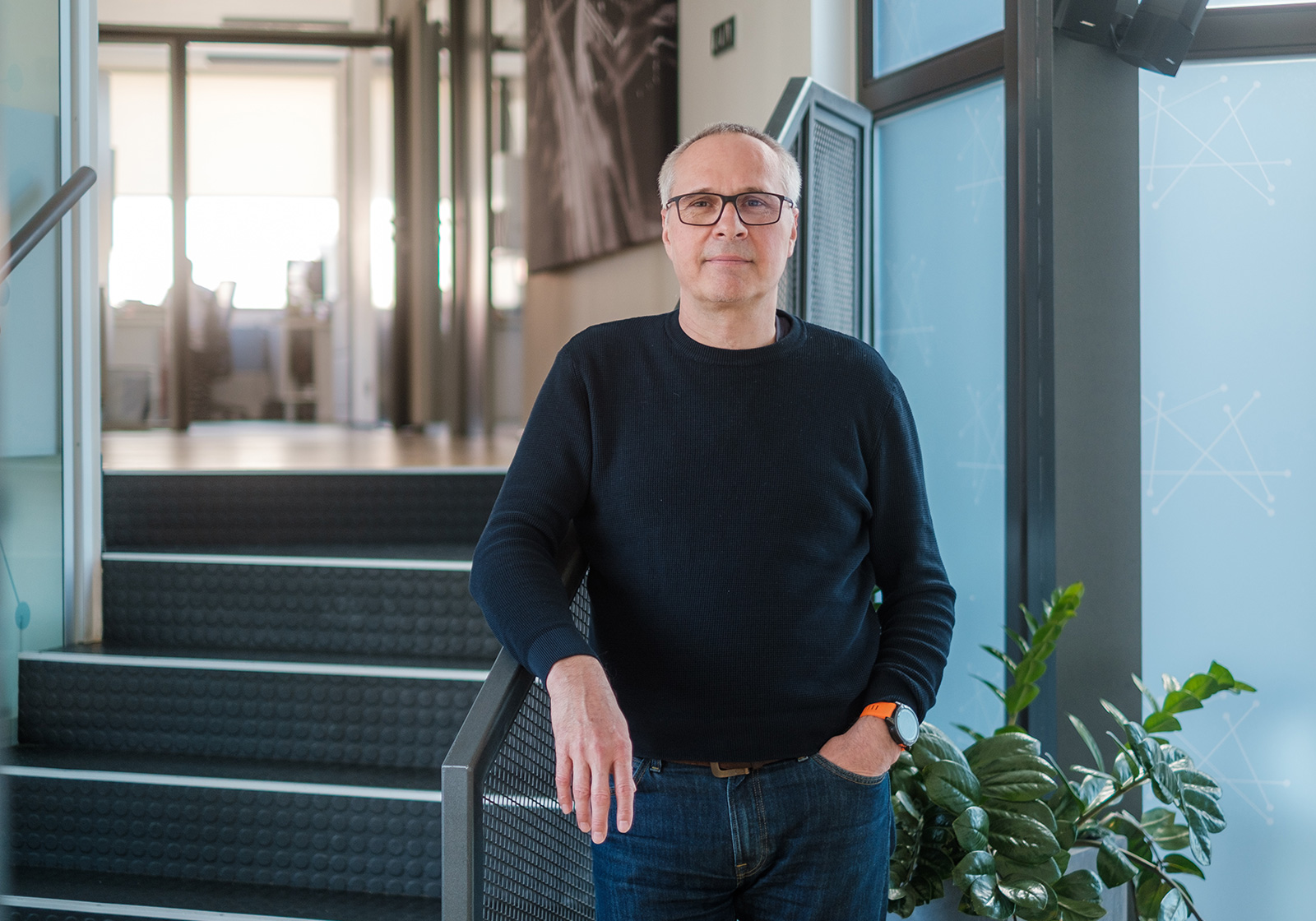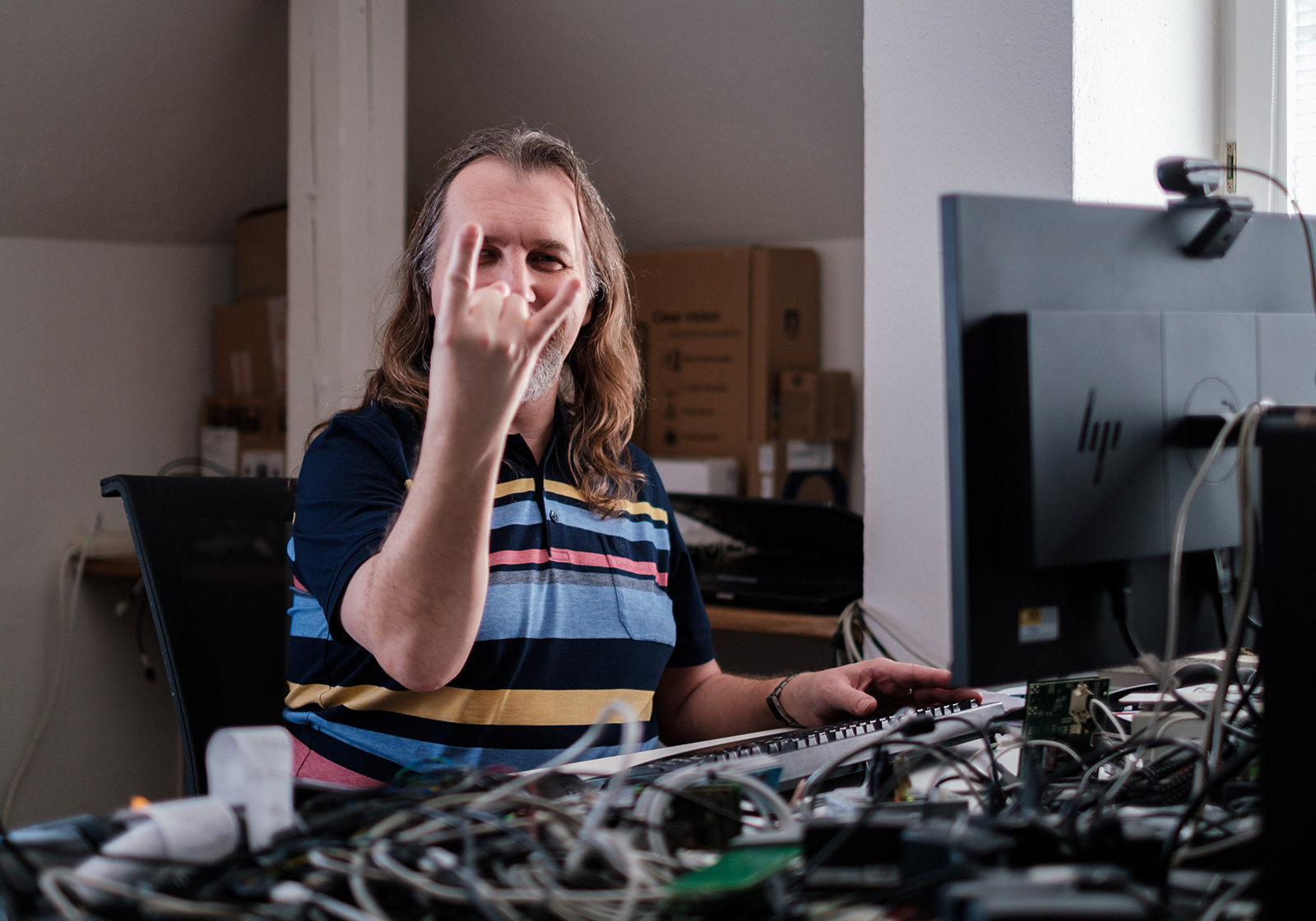
Zdeněk Skalák joined Monet+ in 1999. Back then, the company had eighteen employees, including the cleaning lady. Today, there are over three hundred, and they proudly hold the title of Company of the Year 2025. As a developer, Zdeněk has been at the center of the biggest technological milestones—from the revolutionary ASORS banking system and biometric passports to card payments in public transport. How does he remember smuggling terminals across borders or the extreme shifts during system deployments?
Zdeněk, you joined Monet+ in 1999. What did this company—now worth hundreds of millions—look like back then, and what were you “thrown into” as a rookie?
We were a tiny company. There were eighteen of us in total, including the cleaning lady, who also used to serve us lunch back then. Right after I started, they sent me to Slovakia for two weeks for a major project for the Slovnaft gas station network. My task was pretty intense—during the day, I was loading software into terminals, and at night, I was “bringing to life” the pinpads—the customer keyboards. Logistically, it was the Wild West. People from Monet+ were moving and swapping terminals all over Slovakia in waves. One colleague even sneaked them across the border with a funny cover story—claiming they weren’t terminals, but “special calculators with paper rolls.”
You were then there for the birth of the ASORS banking system, which today processes millions of transactions daily. What was the biggest revolution back then?
The most innovative part was that we built the entire authorization system on Linux. Until then, all these massive banking systems ran exclusively on giant, expensive mainframes or Windows NT. But we decided to bet on Linux. We trusted it; even though it’s an open-source system (meaning it’s free), it was great to work with, and we knew it inside out. Of course, there were some growing pains, but it worked brilliantly.
A turning point for the whole company was the electronic biometric passports for the State Printing Works of Securities around 2006. Because of that, you and Petr Hanák flew to the US for training with suppliers from DataCard to learn how to work with their giant machines for personalizing contactless smart cards. Word has it you Czechs really showed off your skills there…
That was actually quite funny. The American instructors from DataCard who were supposed to teach us were totally cool and knew exactly what they were doing. The catch was that there were also four Indian employees from a DataCard branch in the training with us. It quickly became clear that while we two Czechs basically had the technology and communication protocols down pat, the guys from India were a bit lost and sometimes couldn’t grasp the technical nuances between APDU case 3 (for contact cards) and APDU case free (for contactless smart cards). So, in the end, we Czechs actually communicated better with the American instructors than their own Indian colleagues did.
There’s a legendary story involving you, the passports, and a coat rack. What happened?
We were developing software that takes data from the authority and reformats it so the machine can print it into the passport and write it to the chip. The data was provided by a company called Komix. During one test, instead of a person’s photo, a photo of an ordinary coat rack was sent to the machine. A perfectly valid-looking passport with a coat rack actually rolled off the line. But the best part? It passed strict quality control as “completely fine”! You see, the check wasn’t just automated—comparing received data with what was read from the chip—there was also a human sitting there comparing the images. And that person, of course, had to click “OK” because they were only verifying if the data printed on paper matched exactly what came in and what we wrote to the chip. From a process standpoint, it was a perfectly and flawlessly manufactured document, even though the system should never have let it through.
But it wasn’t all fun and games back then. I heard you worked some extreme night shifts?
We did; there were plenty of those extremes. Around 2005 and 2006, we were working on two massive things at once. There were two crews—one worked at the State Printing Works (STC) on passports during the day because the printing house didn’t operate at night, and the second crew worked on the ASORS banking system at night. The problem was, I was in both of them.
But the toughest time was way before that, in 2001, during the first PKI implementation for Komerční banka (the “Můj klíč” project). We lived in a hotel in Prague for a month straight, waking up at 7:00 AM and returning at 3:00 or 4:00 AM. After a few weeks, it was madness. One morning, we had to climb over a balcony to get to our colleagues’ room because they weren’t opening the door at all. We found one developer sleeping standing up right under a running shower, and another had fallen asleep sitting on the bed while tying his shoe. We were completely out of it from exhaustion.
Moving forward in time, you’re also an expert on payment terminals and helped launch smart card payments in public transport. The Czech Republic was quite ahead of the curve in that, right?
We were de facto the first right after London, which we used as a model for how it should work. These so-called transport payments work asynchronously and offline. You just “tap” on the bus, you don’t enter a PIN, and the terminal just lightning-fast verifies if the card is genuine and not on a stoplist. The actual settlement and deduction of money happen later in batches on the server. This was so new to everyone that we had to explain the logic of this offline system to the processing centers of the time in great detail just so they could actually forward the transactions for settlement.
Monet+ has grown tremendously; we provide solutions for the biggest banks and corporations. Has your approach to customers changed at all with the size of the company?
I don’t care about the size; I’m just a tech guy. I enjoy digging into things, figuring out how they work, and coming up with ways to make them work even better. When there’s some nonsense being discussed at a meeting with a customer, I have no problem saying it straight. And as for a dress code for those big corporations—I’ll happily show up at a bank or a major telecom operator without a suit. I always say: I’m here to sell you my knowledge, not my looks. And that’s what really matters in IT.