Certificate Lifecycle Management
Full Automation On-Premise Instalation Automated Issuance
End of Manual Management
Automate Your Certificates Lifecycle with On-Premise CLM
Gain full control over your organization’s digital certificates with our on-premise Certificate Lifecycle Management (CLM) platform. This tool fully automates certificate issuance directly on your servers, simplifying administration for IT teams.
Fully On-Premise solution to ensure security and enforcing cryptographic policies.
Quick installation and integration with internal systems and certification authorities.
It is easy to use, with a clean interface that doesn’t burden hardware or software performance.
Discovery
Automatic scanning and mapping of all network certificates across Windows, Linux, and macOS environments.
Full Lifecycle Automation
Automated request submission, approval, issuance, installation, and renewal without any human intervention.
Advanced Monitoring
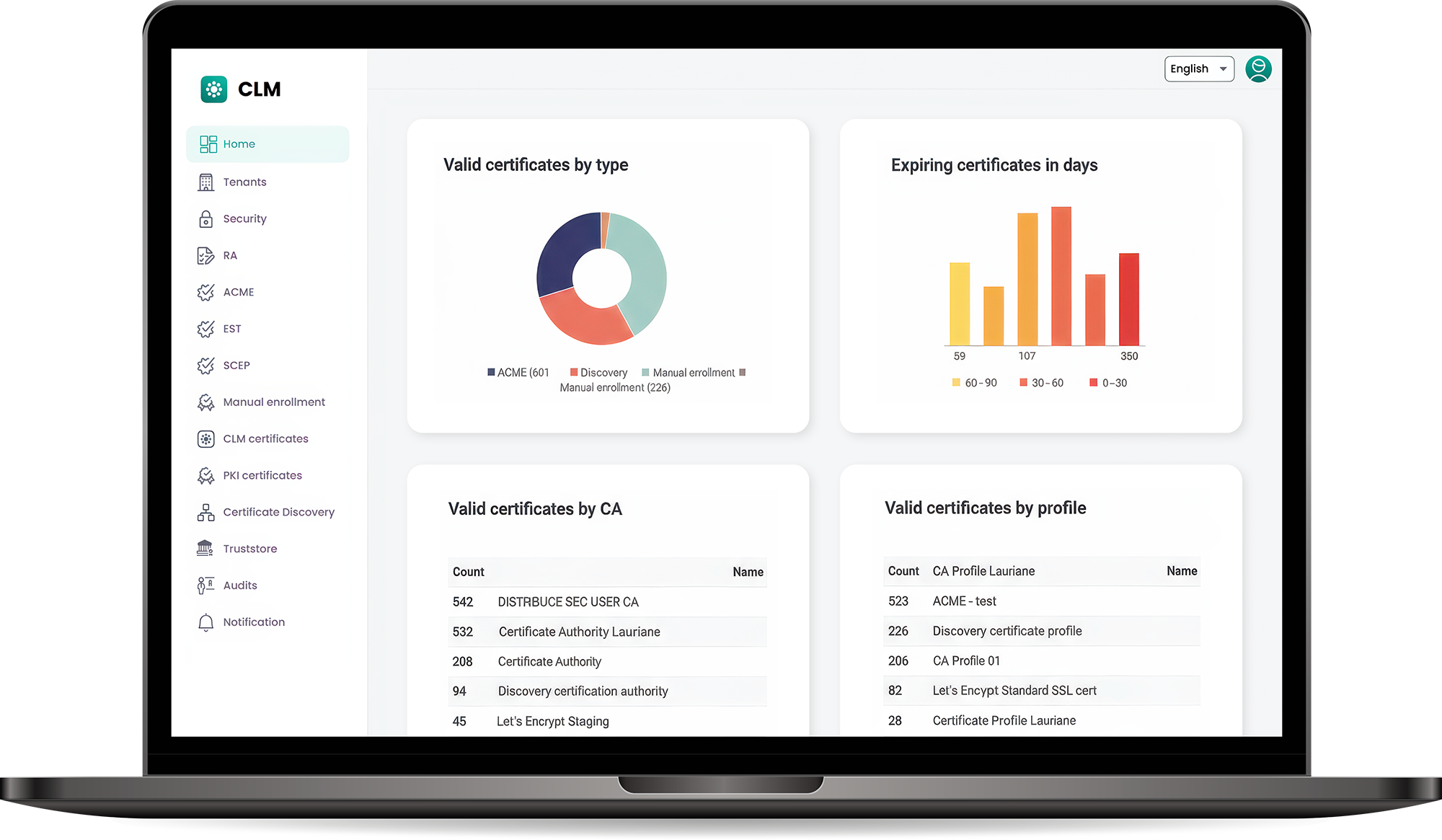
Clear dashboards, filtering by authorities, and providing timely warnings before expiration.
Security Policy Enforcement
Checking of key strength, permitted cryptographic algorithms, and correctness of CSR requests.
Time Savings and Enhanced SecurityThe certificate management module transforms manual, error-prone PKI and Active Directory operations into an automated workflow.
Who is it for?
Tailored to the Specific Needs and Use Cases
Supported CLM ProtocolsMonet+ CLM is an on-premise Certificate Lifecycle Management platform designed to automate the full lifecycle of digital certificates, including issuance, renewal, and revocation. The system supports standardized protocols to facilitate automated certificate enrollment across diverse network entities.
ACME Protocol
- Implementation of a general ACME server according to RFC 8555
- Compatible with the most widely used global ACME clients
- Unique ACME External Account Binding concept – tailored for the internal ACME server model issuing certificates from an internal Certificate Authority
- Suitable for SSL certificates (Domain Validation certificates)
EST Protocol
- Implementation of the EST protocol according to RFC 7030
- Dynamic configuration of EST endpoint authorization rules (for authentication via client certificate or username/password)
- Optional device serial number verification in the certificate request
- Suitable (but not limited) for network element certificates
SCEP Protocol
- Implementation of the SCEP protocol according to RFC 8894
- Suitable (but not limited) for network element certificates
Proprietary Protocol
- We can develop support for a proprietary protocol tailored to the customer’s needs
- Applicable to devices or systems with custom PKI interface implementations
CLM Protocol
Automation of certificate issuance and deployment using CLM agents (suitable for Windows, Linux, and macOS systems).
Manual Certificate Issuance from the CLM Portal
Via Form – The user enters the certificate parameters (identification data) into the form, the CLM system generates the keys and CSR, and issues the certificate, which can then be exported with the private key.
Via CSR Import – The administrator imports the generated Certificate Signing Request (CSR).
KMIP Protocol
Implementation of the OASIS KMIP standard with support for multiple protocol versions for universal deployment.
Management of the entire lifecycle of encryption keys (creation, policy management, deletion).
Secure connection of applications with a hardware vault (HSM Vault).
Pre-prepared scenarios:
VMware vSphere / vSAN Encryption: Secure encryption of virtual machines and disk arrays.
Database encryption: Centralized protection and key management for core databases.
Backup software (e.g., CommVault): Encryption of sensitive backups and data before their final write to disk or tape.
Other Features
Integration with network elements (e.g., F5 BIG-IP), cloud workloads (Kubernetes/Docker), and both internal and public certificate authorities (CAs).
Integration with public certificate authorities (CZ/SK).
Support for strong cryptography (crypto-agile solution). We are ready for post-quantum cryptography (PQC).